
Sleep better, naturally. Starting tonight.
This guide is for adults who feel exhausted at night but cannot seem to switch off. You will learn calming activities before bed for adults that gently shift your nervous system so sleep comes more easily.
Key takeaways
- Calming activities before bed for adults work when they change light, temperature, breath, and cognitive load
- Habits, not willpower or tracking alone, determine sleep quality
- A simple 60-minute sequence can reduce arousal and improve sleep onset without relying on supplements
If your evenings look calm but your body feels alert
Many capable, driven adults wind down in ways that look reasonable on paper. A little LinkedIn scroll. Half an episode of a show. A few last emails. Maybe a glass of wine to take the edge off. Then you get into bed tired, yet wired. Your jaw is tight. Your mind runs tomorrow’s calendar.
Common advice treats calming activities before bed for adults as a menu of pleasant options. Pick what feels nice and hope your sleep follows.
Your nervous system responds to signals, not vibes. Light, temperature, posture, breath, movement, novelty, threat, and predictability all shape whether your brain powers down. Many evening habits are enjoyable but still keep attention networks online.
This matters because sleep is the foundation of cognitive clarity, mood stability, metabolic health, fitness recovery, relationships, creativity, and long-term brain health. When sleep erodes, every domain feels harder.
What follows is a practical guide to calming activities before bed for adults that change physiology in measurable ways. The goal is not perfection. The goal is a repeatable landing.
Your body falls asleep when signals change
Sleep is an outcome of biology.
Two systems drive the process. First is circadian timing. Light is the strongest cue. Evening light, especially short-wavelength light, can suppress melatonin and delay your internal clock, as shown in controlled laboratory studies such as Brainard et al., 2001 and Zeitzer et al., 2000.
Second is sleep pressure. The longer you are awake, the more adenosine builds. Caffeine blocks adenosine receptors, which is why late caffeine can leave you feeling tired but unable to fall asleep. Landolt, 2008 reviews this mechanism.
Then there is arousal. When your brain reads the evening as unfinished work or high novelty, the sympathetic nervous system remains active. Heart rate can stay elevated. Muscle tone increases. Attention networks stay primed. The hyperarousal model of insomnia describes this pattern in detail in Riemann et al., 2010.
Wearables often reflect this state. You may see higher resting heart rate or lower heart rate variability in the evening. Still, these are correlates. Devices estimate patterns associated with sleep. They do not diagnose causes.
A common myth about calming activities before bed for adults
A popular belief is that any relaxing activity will calm the nervous system.
Relaxing can mean entertained, distracted, or numbed. It does not always mean parasympathetic activation. Social media feels mindless yet delivers novelty, status cues, and emotional spikes. Email keeps goal pursuit alive. Even streaming shows can increase cognitive and emotional arousal.
Research links cognitive arousal with difficulty initiating sleep. Riemann et al., 2010 summarizes strong associations between pre-sleep rumination and insomnia symptoms.
Calming activities before bed for adults are most effective when they change inputs the nervous system uses to judge safety. Light becomes dimmer. Tasks close. Breath slows. The sequence becomes predictable.
Science here has nuance. Not every person responds the same way to every input. Some people read fiction and fall asleep easily. Others find reading stimulating. Personal patterns matter more than rigid rules.
Calming activities before bed for adults that shift physiology
You do not need a long list. You need a few signals you repeat.
Dim the lights early
Use lamps instead of overhead lighting. Lower screen brightness if you must use devices. Blue light filters can help slightly, but intensity and duration of light exposure still matter.
Controlled studies show that bright evening light suppresses melatonin and shifts circadian timing. See Zeitzer et al., 2000 in The Journal of Physiology.
This step removes a strong wake signal. It is simple and often underestimated.
A short, easy walk after dinner
A 10 to 20 minute walk at an easy pace can create a psychological transition from work mode to home mode. Light movement may reduce stress reactivity and support digestion.
Keep intensity low. The purpose is a gentle shift in state. When the walk becomes competitive or performance driven, arousal can rise instead of fall.
A warm shower or bath 60 to 90 minutes before bed
Passive body heating increases blood flow to the skin. After you step out, heat dissipates and core body temperature declines. A falling core temperature is part of normal sleep onset.
A meta-analysis in Sleep Medicine Reviews found that appropriately timed warm showers or baths were associated with shorter sleep onset latency and improved sleep quality, Haghayegh et al., 2019.
This is one of the more evidence-aligned calming activities before bed for adults who feel physically tense.
A contained brain unload
If your mind runs tomorrow’s to-do list, give it a clear container.
- Write tomorrow’s top three outcomes
- List open loops
- Note the first next step for each
- Close the notebook
A randomized study found that writing a to-do list before bed reduced time to fall asleep compared with writing about completed activities, Scullin et al., 2018 in the Journal of Experimental Psychology: General.
The stop point matters. Analysis can quickly turn into late-night problem solving.
Slow breathing with a longer exhale
Try inhaling gently through your nose for four seconds and exhaling for six to eight seconds. Continue for three to five minutes.
Slower breathing patterns with extended exhalation can increase parasympathetic influence in many people. The effect size varies, and it is not a cure-all. Still, it is portable and low risk.
If you have a history of panic symptoms, keep the breaths natural. Gentle is enough.
A repeatable 60-minute wind-down
Structure supports habits. Habits determine sleep quality more than willpower or motivation.
60 to 40 minutes before bed
Dim lights. Adjust the bedroom temperature if possible. Place your phone on a charger outside the bedroom or across the room.
Environmental signals come first. Your brain notices them before it notices your intentions.
40 to 25 minutes before bed
Choose one: warm shower, gentle stretching, or an easy walk. Avoid tracking pace or calories. Keep the tone restorative.
25 to 15 minutes before bed
Do the five to ten minute brain unload. Write tomorrow’s top three outcomes. Identify the first step. Then close the notebook.
15 to 5 minutes before bed
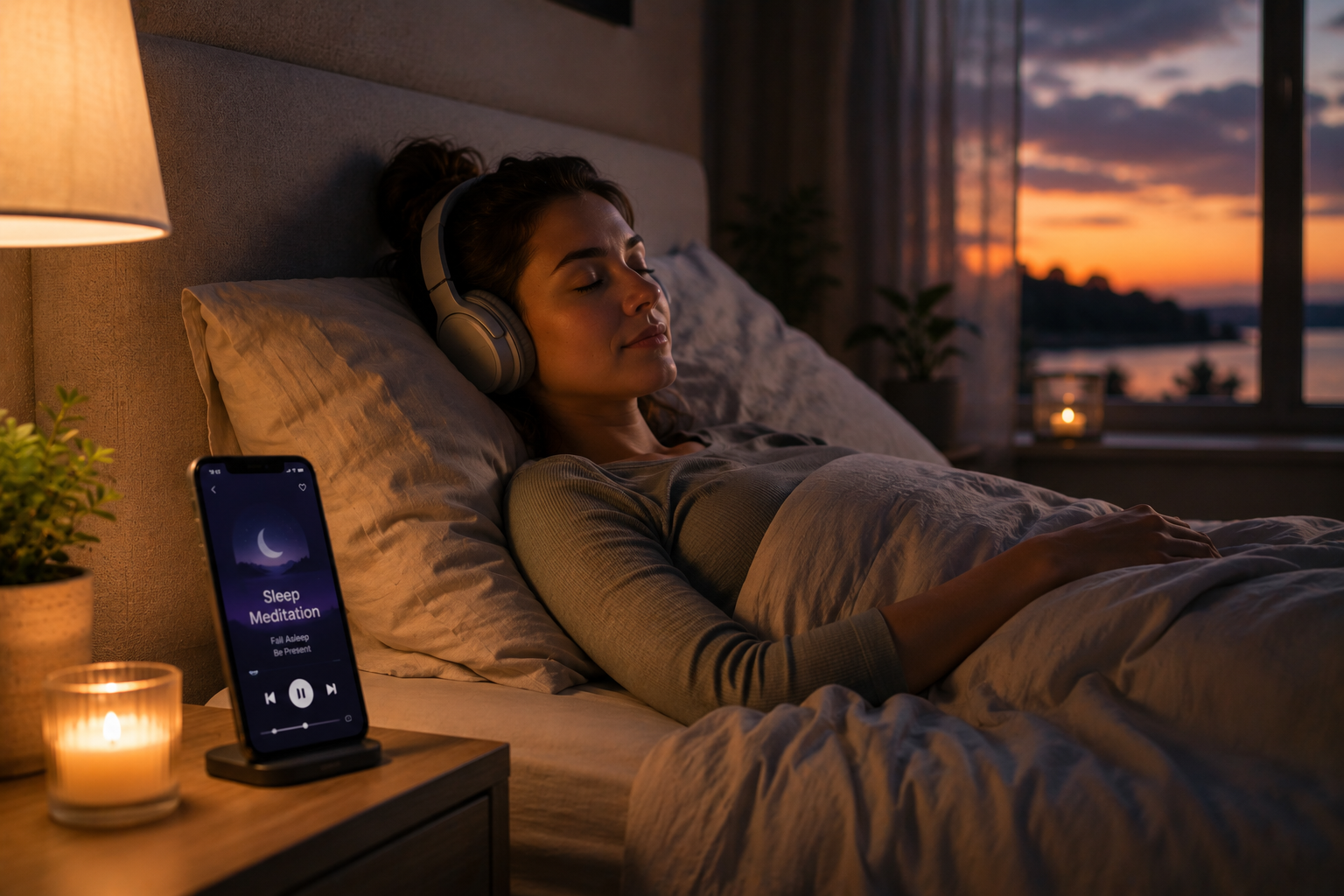
Practice three to five minutes of slow breathing or listen to a brief, non-stimulating body scan.
Last five minutes
Keep light low. Follow the same order each night. Predictability communicates safety. Safety supports sleep.
Using wearables to support calming activities before bed for adults
Oura, WHOOP, Apple Watch, and Fitbit can offer helpful trends. They are not diagnostic tools.
Wearables can show patterns in bedtime consistency, estimated total sleep time, resting heart rate, and heart rate variability. Reviews such as Depner et al., 2020 in Sleep explain both the promise and the limitations of consumer sleep technology.
Sleep stage data from these devices are estimates. Polysomnography remains the clinical standard.
Tracking alone does not drive results. Behavior change does.
Try a simple loop. Pick one calming activity before bed for adults, such as dimming lights earlier. Repeat it for seven nights. Review bedtime consistency, time to fall asleep, and resting heart rate trends. Then decide whether to keep or adjust the habit.
The uncomfortable habit most people avoid
A real screen curfew is often the highest leverage shift.
Set a boundary for algorithm-driven apps in the final 60 minutes. Social media, news, and inbox keep reward circuits engaged. Removing them can feel uncomfortable for a few nights.
That discomfort is information. It often reveals how much stimulation your brain carried through the day.
Replace the phone with one defined activity from your wind-down plan. Friction should be low. When habits are easy, they stick.
What not to do if you want this to work
Alcohol may shorten sleep onset for some people, yet it often increases awakenings and fragments sleep later in the night. Ebrahim et al., 2013 in Alcoholism: Clinical and Experimental Research reviews these effects.
Intense problem solving in bed trains your brain to associate the bed with wakefulness. Keep planning at a desk in dim light.
Chasing a perfect supplement stack can distract from core behaviors. Magnesium, glycine, L-theanine, and melatonin have mixed evidence for routine insomnia. Melatonin shifts circadian timing more reliably than it sedates. Dose and timing are often misused.
Obsessing over nightly sleep scores can increase anxiety. Baron et al., 2017 described this pattern as orthosomnia in the Journal of Clinical Sleep Medicine.
A simple checklist for tonight
Pick two non-negotiables:
- Dim lights and avoid overhead lighting
- Place your phone outside the bedroom
- Complete a five to ten minute brain unload
Pick one downshift:
- Warm shower 60 to 90 minutes before bed
- Ten minute easy walk after dinner
- Three to five minutes slow breathing
If you wake during the night and feel alert, avoid clock watching. If you are awake for what feels like 20 to 30 minutes, get up briefly in low light and read something neutral. Return to bed when sleepy.
Persistent difficulty falling or staying asleep deserves clinical evaluation. Conditions such as sleep apnea, restless legs syndrome, reflux, medication effects, or circadian misalignment may require targeted care.
Build a repeatable landing
The aim is not perfect calm. The aim is a nervous system that trusts your evenings.
Progress looks like fewer wired nights and quicker recovery after a late one. Over time, consistent calming activities before bed for adults become cues your brain recognizes.
Habits shape sleep. Sleep shapes everything else.
If you want a personalized starting point, you can request a complimentary assessment at Clementine Coach.
Start with dimming lights, stopping email and social media for the final hour, doing a five to ten minute to-do list, and practicing three to five minutes of slow breathing with a longer exhale. These steps reduce light exposure and cognitive arousal, two common drivers of the tired but wired feeling.
Thirty to sixty minutes works well for most people. Consistency matters more than duration. A shorter routine done nightly is more effective than a long routine done occasionally.
Wearables can highlight trends in bedtime consistency, estimated sleep onset, and resting heart rate. They cannot diagnose sleep disorders or precisely measure sleep stages. Use them to test habits over a week at a time rather than reacting to nightly scores.
Alcohol can make you feel sleepy at first, but it often fragments sleep later in the night and reduces overall sleep quality. If you drink, keep it moderate and earlier in the evening.
GET IN TOUCH
Say goodnight to bad sleep
References
- Baron, K. G., Abbott, S., Jao, N., Manalo, N., & Mullen, R. (2017). Orthosomnia: Are some patients taking the quantified self too far? Journal of Clinical Sleep Medicine, 13(2), 351–354.
- Brainard, G. C., et al. (2001). Action spectrum for melatonin regulation in humans. The Journal of Neuroscience, 21(16), 6405–6412.
- Depner, C. M., et al. (2020). Wearable technologies for developing sleep and circadian biomarkers. Sleep, 43(2), zsz254.
- Ebrahim, I. O., et al. (2013). Alcohol and sleep I: Effects on normal sleep. Alcoholism: Clinical and Experimental Research, 37(4), 539–549.
- Haghayegh, S., et al. (2019). Passive body heating to improve sleep. Sleep Medicine Reviews, 46, 124–135.
- Landolt, H. P. (2008). Sleep homeostasis and adenosine in humans. Biochemical Pharmacology, 75(11), 2070–2079.
- Riemann, D., et al. (2010). The hyperarousal model of insomnia. Sleep Medicine Reviews, 14(1), 19–31.
- Scullin, M. K., et al. (2018). Bedtime writing and sleep onset latency. Journal of Experimental Psychology: General, 147(1), 139–146.
- Zeitzer, J. M., et al. (2000). Sensitivity of the human circadian pacemaker to nocturnal light. The Journal of Physiology, 526(3), 695–702.