
Sleep better, naturally. Starting tonight.
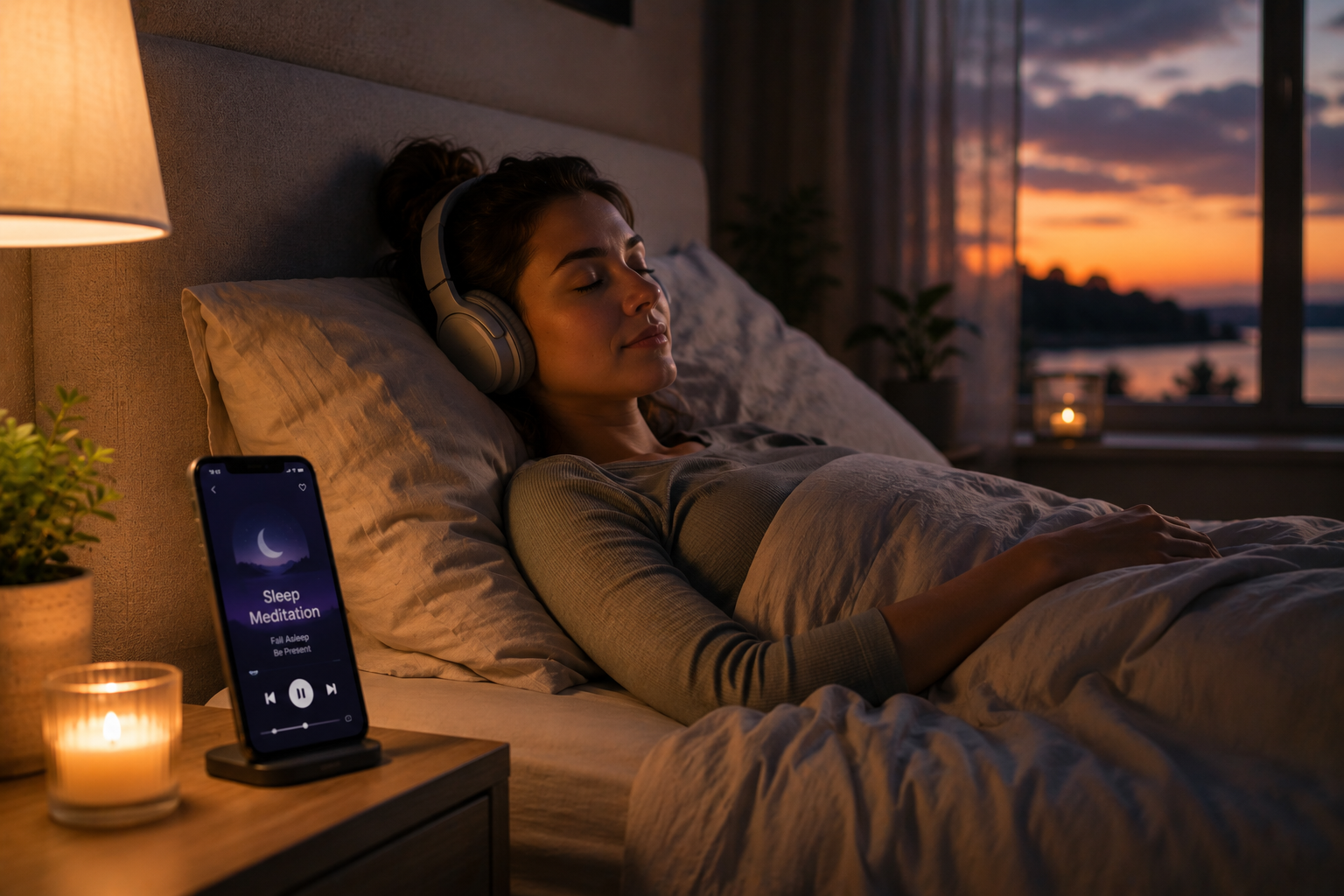
If you struggle to fall asleep because your mind will not slow down, this guide is for you. You will learn how to use sleep meditation as a practical, science-based tool instead of another bedtime experiment.
Key takeaways
- Sleep meditation works by reducing hyperarousal, not by “clearing your mind.”
- Habits and timing matter more than apps or one-night wearable scores.
- A simple 10–15 minute sequence can make sleep onset easier when stress is the main driver.
Sleep meditation is not about clearing your mind
A lot of people try sleep meditation once or twice, usually through an app. They listen to a calm voice, notice their thoughts getting louder, and decide they are bad at it.
That conclusion makes sense. It is also usually wrong.
Sleep meditation is not a personality trait. It is a timed nervous system intervention. The goal is not mental silence. The goal is to reduce hyperarousal so sleep onset becomes easier.
Hyperarousal means your brain and body are still in “on” mode at bedtime. It is a well-described contributor to insomnia symptoms, especially prolonged sleep latency. Cognitive behavioral therapy for insomnia, or CBT-I, directly targets this pattern and remains the first-line treatment for chronic insomnia Trauer et al., 2015.
Meditative techniques can support that larger behavior plan. In clinical trials, mindfulness-based programs have shown modest to moderate improvements in sleep for some groups, though not everyone responds and effects are not universal Black et al., 2015.
The nuance matters. Sleep meditation is not a cure for every sleep problem. It is most reliable when stress and racing thoughts are the main issue.
What sleep meditation can and cannot fix
Sleep meditation tends to help with:
- Stress-related difficulty falling asleep
- Racing or repetitive thoughts at night
- A body that feels tired but wired
It is less reliable when the root cause is circadian misalignment, untreated sleep apnea, restless legs syndrome, or chronic pain. In those cases, meditation may improve coping but not resolve the driver.
This is where many people get misled. Popular content suggests sleep meditation can “boost deep sleep” or permanently rewire your nights. Current consumer wearables cannot measure brain waves, so they estimate sleep stages. A single night of higher “deep sleep” on your watch does not prove a physiological shift.
Sleep is the foundation of cognitive clarity, mood stability, metabolic health, physical recovery, creativity, and long-term brain health. That is why we focus on behavior change first. Tracking alone does not drive results. Habits do.
The real mechanism behind sleep meditation
If you want sleep meditation to work, focus on attention control.
Your brain shifts between networks that handle task focus, self-referential thinking, and salience detection. Under stress, the salience system keeps tagging thoughts as urgent. Meditation practice trains you to notice those tags and redirect attention with less reactivity. Proposed mechanisms include changes in emotion regulation and stress appraisal Hölzel et al., 2011.
For sleep, the takeaway is simple. You are not chasing calm. You are practicing returning attention to a neutral anchor until your nervous system gets the message that nothing needs solving.
If your brain is loud, the win is not silence. The win is less chasing.
If racing thoughts are your main issue, this guide on racing thoughts keeping you awake can help you pair sleep meditation with the right cognitive steps.
The best sleep meditation sequence for high-stress nights
Most people choose a technique based on what sounds relaxing. A better approach is to match the tool to your arousal level.
When your day has been intense, start with the body. Then move to the breath. Add progressive muscle relaxation if you need a stronger signal.
This order moves from concrete sensations to subtler awareness. It makes sleep meditation easier to stick with.
Step 1: a three-minute arrival
Many people skip this. It is often why sleep meditation feels ineffective.
Sit or lie down. Close your eyes or soften your gaze. For three minutes:
- Feel contact points such as head, back, hips, and heels
- Notice temperature and weight
- Name five sensations silently without judging them
This turns meditation into a transition instead of an escape.
Step 2: body scan when the mind is loud
Move attention slowly from forehead to feet. If you get lost, return to the last place you remember.
A body scan gives your brain a structured task. That structure reduces rumination time, which often drives longer sleep latency.
If you wake at 2 a.m., combine this with a clear plan for awakenings, like the one outlined in why you keep waking up at 2am. What you do after waking often matters more than the technique itself.
Step 3: breath-anchored awareness without control
Use the breath as an anchor. Do not force it.
Feel the breath at the nostrils, chest, or belly. When the mind wanders, label it softly as “thinking” and return.
This repetition is the intervention.
Some breathing exercises can help lower physiological arousal. Others can increase vigilance if done aggressively. Start with awareness. Add structured breathing only if it reliably calms you.
Step 4: progressive muscle relaxation as a stronger off-switch
Progressive muscle relaxation has a long history in behavioral sleep medicine and is included in insomnia guidance from the American Academy of Sleep Medicine.
Tense a muscle group for five seconds. Release for ten to fifteen seconds. Notice the contrast. Move from hands to feet.
This works well if you carry tension in your jaw, shoulders, or hips.
Step 5: one sentence that closes the day
Choose one simple line:
- Nothing needs fixing tonight.
- Tomorrow will handle itself.
- Rest is recovery.
Your brain often treats bedtime as the only quiet problem-solving space it gets. A closing line creates a boundary.
Wearables and sleep meditation: from data to behavior
Oura, WHOOP, Apple Watch, and Fitbit can be helpful when used wisely.
They can reasonably show trends in total sleep time, bedtime consistency, and overnight heart rate. Heart rate variability trends may also be useful, though accuracy varies by device and context.
They cannot diagnose sleep disorders. They cannot measure brain waves. They cannot confirm that one night of sleep meditation increased deep sleep in a meaningful way.
Instead of chasing nightly scores, use a behavior loop:
- Choose one sleep meditation practice, such as a 12-minute body scan.
- Do it five nights per week for two weeks.
- Track sleep latency, awakenings, and how you feel at 11 a.m.
- Review wearable trends only after the two-week block.
This approach reinforces a core truth. Data does not change sleep. Repeated behavior does.
If you want to improve the environment around your sleep meditation, start with how to make your bedroom good for sleep. Light, temperature, and noise reduce the amount of work your nervous system has to do.
The uncomfortable habit that changes everything
Most people look for a better technique. The highest-leverage change is earlier.
Set a real cutoff for email, news, and problem-solving at least 60 minutes before bed.
This is uncomfortable. It is also powerful.
Your brain does not move from high-stakes decisions to safe sleep without a bridge. Sleep meditation works best inside a consistent wind-down window.
If 60 minutes feels unrealistic, start with 20. Move your phone out of the bedroom. Do sleep meditation before you are already frustrated in bed.
Habits, not willpower, determine sleep quality. Build a system that makes the downshift automatic.
If you are unsure about timing, this guide on the scientifically best time to sleep and wake up can help you anchor your schedule.
What not to do if you want sleep meditation to work
Common mistakes are predictable.
- Do not use sleep meditation only as an emergency rescue. Skills build through repetition.
- Do not change techniques every night. Consistency trains the nervous system faster.
- Do not meditate in bed if your bed has become a cue for wakefulness. Use a chair, then go to bed when sleepy. This aligns with stimulus control principles in CBT-I Trauer et al., 2015.
- Do not chase deep sleep scores. Obsessing over metrics can increase arousal.
- Do not assume more effort equals better results. Straining to relax keeps the system engaged.
A simple 10 to 15 minute sleep meditation plan
Use this checklist tonight:
- Dim lights and put your phone away.
- Do a three-minute arrival.
- Complete a five-minute body scan.
- Practice three minutes of breath awareness.
- Add progressive muscle relaxation if needed.
- End with one closing sentence.
If you cannot fall asleep and have an early morning, this practical guide on what to do when you can’t sleep and have to wake up early pairs well with sleep meditation.
Progress over perfect
Sleep meditation is not about becoming a different person. It is about practicing a repeatable downshift so your nights are not decided by how intense your day was.
When you treat sleep meditation as a physiological skill, consistency improves. As consistency improves, sleep often follows.
Sleep supports your focus, mood, metabolism, relationships, and long-term brain health. That is why this work matters.
If you want a personalized starting point, a complimentary assessment at Clementine can help you build a plan around your schedule and sleep patterns.
</Sleep meditation can help reduce mental and physical arousal at bedtime, which may shorten the time it takes to fall asleep. Effects are usually modest and depend on the cause of your sleep difficulty. It works best when stress and racing thoughts are the main drivers.
A structured body scan is often easiest because it gives the mind a clear task. If you carry a lot of tension, progressive muscle relaxation may feel more concrete and calming.
Wearables can show trends in total sleep time and consistency over weeks. They cannot measure brain waves or confirm that one night of meditation increased deep sleep. Focus on behavior consistency and how you feel the next day.
GET IN TOUCH
Say goodnight to bad sleep
References
- Trauer, J. M., Qian, M. Y., Doyle, J. S., Rajaratnam, S. M. W., & Cunnington, D. (2015). Cognitive behavioral therapy for chronic insomnia: A systematic review and meta-analysis. Annals of Internal Medicine, 163(3), 191–204.
- Black, D. S., O’Reilly, G. A., Olmstead, R., Breen, E. C., & Irwin, M. R. (2015). Mindfulness meditation and improvement in sleep quality among older adults with sleep disturbances. JAMA Internal Medicine, 175(4), 494–501.
- Hölzel, B. K., Lazar, S. W., Gard, T., Schuman-Olivier, Z., Vago, D. R., & Ott, U. (2011). How does mindfulness meditation work? Perspectives on Psychological Science, 6(6), 537–559.
- American Academy of Sleep Medicine. (2021). Clinical practice guidelines and resources for insomnia.