
Sleep better, naturally. Starting tonight.
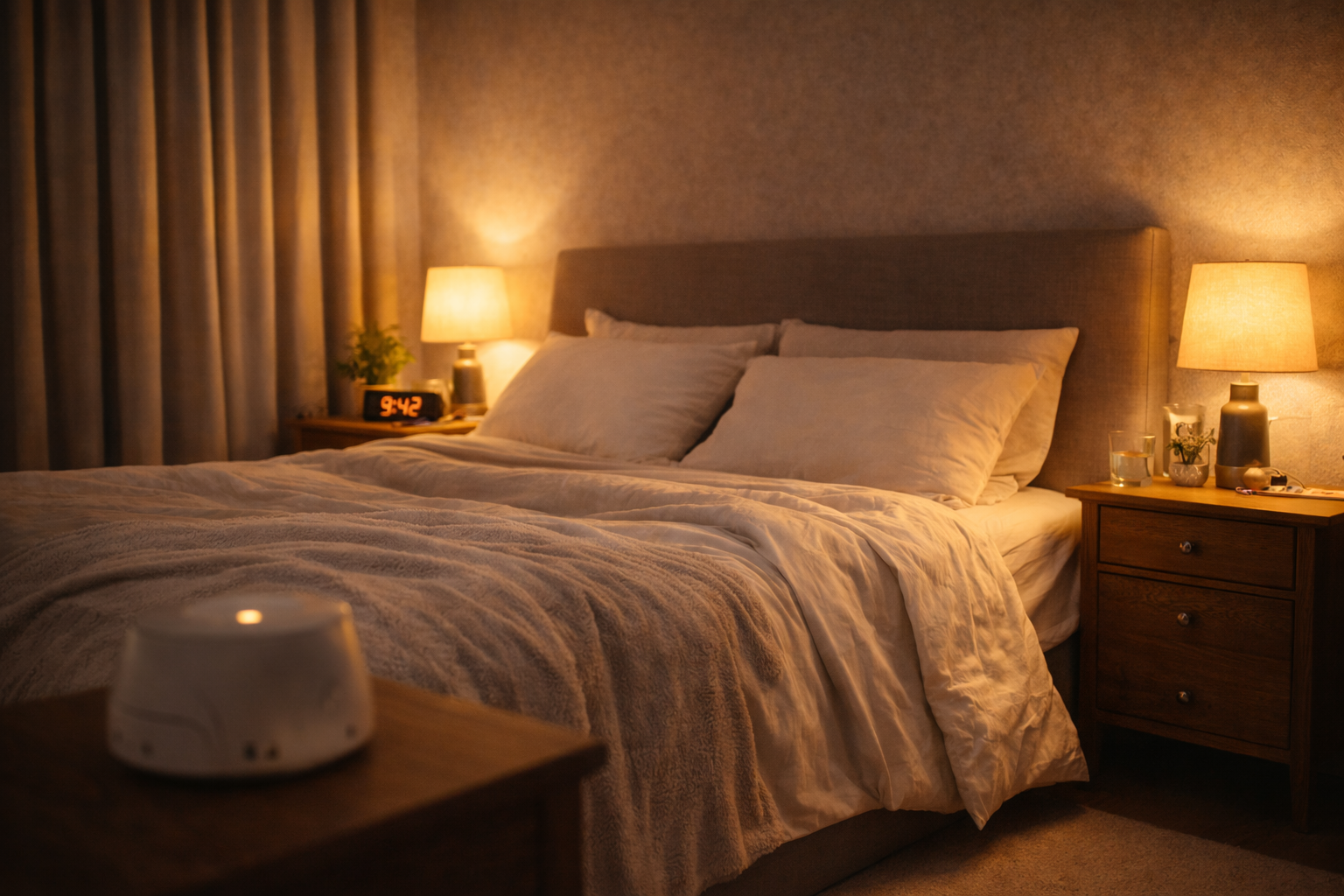
If your sleep feels inconsistent, this guide will help you make bedroom good for sleep using science, not guesswork. You will learn which small environmental changes can shift real sleep biology and which popular upgrades are often overstated.
Key takeaways
- Your bedroom sends biological signals that shape melatonin, temperature regulation, and nighttime arousal.
- Habits, not tracking or expensive gear, determine whether you make bedroom good for sleep.
- Small, consistent environmental changes often improve sleep more than supplements.
Your bedroom is sending signals all night
If your Oura or WHOOP scores bounce around, it is easy to blame stress, aging, or being a light sleeper. Sometimes that is true. Often, the environment is quietly contributing.
Your bedroom is not just a comfort zone. It is biological input.
Light shifts melatonin timing. Temperature affects whether your core body temperature can fall, which is required for sleep onset. Noise influences how often your brain performs micro safety checks. Even subtle signals matter when they repeat every night.
Sleep is the foundation of cognition, mood, metabolic health, fitness recovery, relationships, and long-term neurological resilience. Protecting it is not indulgent. It is strategic.
To make bedroom good for sleep, think less about decoration and more about signal control.
The physiology behind how to make bedroom good for sleep
Sleep is not a switch. It is a coordinated process shaped by two major systems.
Circadian timing. Your suprachiasmatic nucleus uses light and routine to predict night. Light is the strongest cue, as outlined by the NIH National Institute of General Medical Sciences. When evening light is bright or blue enriched, melatonin can be delayed.
Sleep pressure. The longer you are awake, the more homeostatic pressure builds, partly through adenosine signaling. This process is reviewed in sleep homeostasis research by Porkka-Heiskanen (2013).
Your bedroom primarily affects circadian signaling and nighttime arousal. If you want to make bedroom good for sleep, align those signals consistently.
The myth: a perfect room guarantees perfect sleep
A common belief is that if you engineer the ideal sleep cave, sleep will become flawless. Evidence does not support that promise.
Genetics, hormones, stress, medications, travel, and pain all shape sleep architecture. Even in ideal conditions, normal variation exists. Research on insomnia shows that effortful control and hyperfocus on sleep can worsen arousal and delay sleep (Harvey, 2002).
Optimization helps. Perfection is neither realistic nor required.
The goal is to make bedroom good for sleep in a stable, boring way. Then allow biology to do its work.
How to make bedroom good for sleep by managing light
Light influences circadian timing more than most people realize.
Even moderate indoor evening light can suppress melatonin onset in some individuals, as demonstrated in controlled laboratory studies (Gooley et al., 2011). Evening use of light emitting devices has also been shown to delay circadian timing and reduce next-morning alertness (Chang et al., 2015).
Small reductions often create meaningful shifts.
To make bedroom good for sleep tonight:
- Cover or remove visible LEDs from routers, clocks, and chargers.
- Use dim, warm lighting for bathroom trips.
- Keep your phone off the nightstand if possible. Not as a moral stance, but because it is a light and stimulation source.
Individual sensitivity varies. Age, lens changes, and chronotype affect light response. Aim for consistent reduction, not extreme darkness that feels unsafe.
How to make bedroom good for sleep with temperature that supports cooling
Falling asleep requires a drop in core body temperature. The body increases heat loss through the hands and feet to support this process, a phenomenon described in thermoregulation research by Kräuchi (2007).
A cooler environment can assist that heat loss. There is no universal magic number.
Many people do well in the mid to upper 60s Fahrenheit. Bedding, humidity, airflow, body composition, and menopausal status all influence comfort.
If you wake between 2 and 4 a.m. feeling restless or warm, temperature may be a hidden driver.
- Lower the thermostat 1 to 3 degrees for one week and compare outcomes.
- Use layered bedding instead of one heavy duvet.
- Consider a warm shower 1 to 2 hours before bed. Passive body heating can shorten sleep onset latency in some individuals by promoting subsequent heat loss (Haghayegh et al., 2019).
Cool is supportive. Cold stress that makes you tense is counterproductive.
How to make bedroom good for sleep by reducing noise variability
Your brain continues monitoring the environment during sleep. Sudden changes in sound are more disruptive than steady background noise.
A systematic review for the World Health Organization found associations between environmental noise and poorer sleep outcomes (Basner & McGuire, 2018).
To make bedroom good for sleep in noisy settings:
- Mask unpredictable sounds with steady fan or white noise.
- Fix intermittent offenders such as HVAC clicks or phone vibrations.
- Use earplugs if comfortable and safe.
Complete silence is not required. Predictability is often more important than absence.
Wearables can help you make bedroom good for sleep, if you use them wisely
Oura, WHOOP, Apple Watch, and Fitbit estimate sleep using movement and heart rate signals. They are not diagnostic devices. Validation studies show reasonable agreement for total sleep time, with more variability in sleep staging accuracy (de Zambotti et al., 2019).
Metrics do not change sleep. Habits do.
Use wearables to identify patterns:
- Longer sleep onset may point toward light exposure or late stimulation.
- Frequent awakenings may reflect temperature swings, noise, alcohol, or stress.
- Elevated nighttime heart rate can accompany alcohol, illness, overheating, or late meals.
Run simple experiments. Change one variable for seven nights. Track how long it takes to fall asleep, number of awakenings, and how you feel midmorning. Keep other routines stable.
This behavior loop matters more than the nightly score.
The uncomfortable but powerful habit most people avoid
If you truly want to make bedroom good for sleep, consider removing the television and relocating work from the bed.
This boundary is uncomfortable because it challenges routine. It is powerful because of stimulus control.
When the bed becomes a place for email, news, and problem solving, the brain associates it with alertness. Stimulus control therapy, a core component of cognitive behavioral therapy for insomnia, shows strong evidence for improving sleep efficiency (Edinger & Means, 2005).
Start gently if needed. Use auto off timers. Charge the phone outside the room. Move work materials out of sight.
The boundary, not the device, drives the change.
What not to do when trying to make bedroom good for sleep
Avoid common traps that waste effort.
- Do not chase total darkness if it makes you anxious. A very dim, warm nightlight low to the ground is reasonable.
- Do not overcool the room to the point of shivering.
- Do not buy multiple devices at once. More gear often increases monitoring.
- Do not rely on alcohol to fall asleep. Alcohol can shorten sleep onset but fragments sleep later and suppresses REM (Ebrahim et al., 2013).
- Do not check wearable data during nighttime awakenings.
Progress beats perfection.
A simple 30 minute reset to make bedroom good for sleep
You can start tonight.
- Cover visible LEDs.
- Lower the thermostat slightly.
- Turn on a steady fan if noise is variable.
- Set devices to do not disturb.
- Move work and scrolling out of the bed.
Sleep quality reflects repeated behaviors. Tracking alone does not create change. Small environmental habits, done consistently, shift biology over time.
Make the room supportive. Keep the routine steady. Let sleep respond.
That is how you make bedroom good for sleep in a way that lasts.
Reduce visible light and stop using the bed for work or scrolling. These changes lower alerting input and strengthen the brain’s association between bed and sleep.
Most people sleep well in a slightly cool room, often in the mid to upper 60s Fahrenheit. Adjust based on whether you wake feeling overheated or tense. Comfort and stability matter more than a specific number.
Wearables can highlight patterns such as frequent awakenings or elevated nighttime heart rate. They cannot diagnose causes. Use the data to guide small environmental experiments rather than chasing scores.
Blackout can help if early light wakes you. However, total darkness is not required for everyone. Consistent, reduced light exposure is usually enough to support melatonin timing.
GET IN TOUCH
Say goodnight to bad sleep
References
- NIH National Institute of General Medical Sciences. (2023). Circadian rhythms fact sheet.
- Porkka-Heiskanen, T. (2013). Sleep homeostasis. Current Opinion in Neurobiology, 23(5), 799–805.
- Gooley, J. J., Chamberlain, K., Smith, K. A., et al. (2011). Exposure to room light before bedtime suppresses melatonin onset. The Journal of Clinical Endocrinology & Metabolism, 96(3), E463–E472.
- Chang, A. M., Aeschbach, D., Duffy, J. F., & Czeisler, C. A. (2015). Evening use of light-emitting eReaders negatively affects sleep. Proceedings of the National Academy of Sciences, 112(4), 1232–1237.
- Haghayegh, S., Khoshnevis, S., Smolensky, M. H., Diller, K. R., & Castriotta, R. J. (2019). Before-bedtime passive body heating to improve sleep. Sleep Medicine Reviews, 46, 124–135.
- Basner, M., & McGuire, S. (2018). Environmental noise and effects on sleep. International Journal of Environmental Research and Public Health, 15(3), 519.
- de Zambotti, M., Cellini, N., Goldstone, A., Colrain, I. M., & Baker, F. C. (2019). Wearable sleep technology in clinical settings. Medicine & Science in Sports & Exercise, 51(7), 1538–1557.
- Edinger, J. D., & Means, M. K. (2005). Cognitive-behavioral therapy for primary insomnia. Clinical Psychology Review, 25(5), 539–558.
- Ebrahim, I. O., Shapiro, C. M., Williams, A. J., & Fenwick, P. B. (2013). Alcohol and sleep I: Effects on normal sleep. Alcoholism: Clinical and Experimental Research, 37(4), 539–549.
- Kräuchi, K. (2007). The human sleep-wake cycle from a thermoregulatory perspective. Physiology & Behavior, 90(2–3), 236–245.
- Harvey, A. G. (2002). A cognitive model of insomnia. Behaviour Research and Therapy, 40(8), 869–893.