
Sleep better, naturally. Starting tonight.
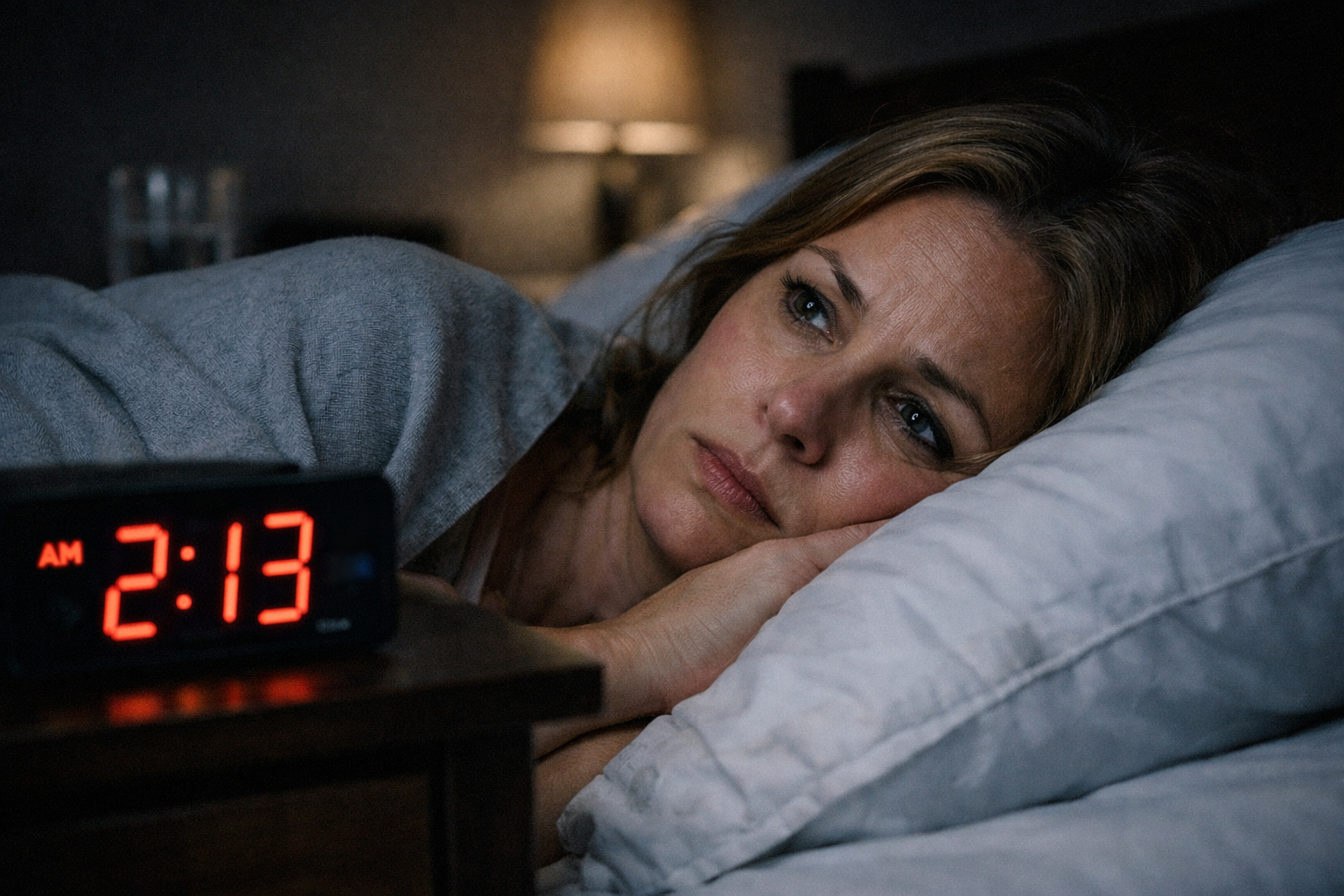
If you are lying awake at 2am or 3am, this is for you. You will learn why do I keep waking up at 2am happens so often in your 30s, 40s, and 50s, and what habits actually help.
Key takeaways
- Waking at 2am or 3am is often a stress and habit pattern, not a broken brain.
- Biology shifts in the late night make you more sensitive to unfinished stress.
- Habits, not tracking alone, determine whether a brief wakeup turns into a long one.
Why do I keep waking up at 2am or 3am?
You fall asleep fine. Then you wake up. Not panicked. Just alert. Your mind starts building tomorrow before you asked it to.
If you track sleep with Oura, WHOOP, Apple Watch, or Fitbit, you may see “awake time” or a dip in HRV. The score catches your attention. The pattern is what matters.
When people ask, why do I keep waking up at 2am, the internet often says insomnia, low blood sugar, or too much caffeine. Those can play a role. Yet for many high performers in their 30s, 40s, and 50s, the explanation is more predictable.
This is often not a disorder. It is a stress and habit problem. The wakeup usually reflects how your day ends, not a flaw in you.
Sleep is the foundation of cognitive clarity, mood stability, metabolic health, fitness adaptation, and even relationship patience. Protecting it is not indulgent. It is strategic.
Waking at 2am can be normal biology
Most adults wake briefly several times each night. That pattern is called sleep architecture, which simply means the natural structure and stages of sleep across the night. We cycle between light sleep, deep sleep, and REM sleep in repeating waves.
Many awakenings are so short you never remember them. Problems start when a brief wakeup turns into a fully alert state.
A common myth says, “If you wake up at 3am, you have insomnia.” Insomnia is a clinical condition defined by ongoing difficulty falling or staying asleep plus daytime impairment despite enough opportunity for sleep, according to the American Academy of Sleep Medicine. One recurring 2am wakeup does not automatically meet that bar.
Many people who ask why do I keep waking up at 2am fall asleep quickly because they are exhausted. That reflects high sleep pressure. Sleep pressure is the body’s drive for sleep that builds the longer you are awake. Scientists also call this the homeostatic drive for sleep. It is like hunger for rest. After several hours of sleep, that drive is lower. You are easier to wake.
What is happening in your body at 2am or 3am
The second half of the night is biologically different from the first.
- Cortisol begins to rise toward morning as part of your circadian rhythm. This rise helps prepare you to wake up. Early work by Weitzman and colleagues showed this late night climb in cortisol before morning awakening.
- Sleep pressure is lower than it was at bedtime, so your brain is not being pushed as strongly into deep sleep.
- REM sleep becomes more common. REM is a lighter stage with more variable heart rate and brain activity, described in standard sleep texts such as Carskadon and Dement.
None of this is a problem by itself. The issue appears when your nervous system is already activated at bedtime.
If your evening includes late work, bright light, alcohol, heavy problem solving, or emotionally loaded conversations, your baseline arousal stays high. Then the normal 2am biology becomes a tipping point.
People often mention the cortisol awakening response. That response happens after you wake in the morning, as reviewed by Clow and colleagues. It is different from the gradual cortisol rise during the late night. If you are asking why do I keep waking up at 2am, you are usually experiencing normal late night biology plus elevated stress, not a dramatic hormone surge.
Why high performers in their 30s, 40s, and 50s notice it more
You are not weak. You are loaded.
Sleep tends to become lighter with age. A large meta analysis in the journal Sleep found gradual changes in sleep continuity across adulthood. That means awakenings can feel more obvious in your 40s and 50s.
Add modern evenings to that biology.
- Cognitive spillover. Your brain never received a clear stop signal.
- Emotional load. Not crisis. Just friction and responsibility.
- Late light. Evening screen light can delay circadian timing and reduce melatonin, as shown in a controlled study by Chang and colleagues in PNAS.
- Alcohol as a downshift. Alcohol can shorten the time it takes to fall asleep but fragment sleep later in the night, according to a review in Alcoholism: Clinical and Experimental Research.
This is why the real answer to why do I keep waking up at 2am is usually upstream.
The uncomfortable habit that works
Most people want a supplement or a 2am breathing trick. The highest leverage change is less exciting.
Set a firm work shutdown time.
Habits, not willpower at 2am, determine whether you stay asleep. If you end intense cognitive work 20 minutes before bed, your nervous system remains on task mode. Physiology is literal.
Choose a shutdown time at least 60 minutes before lights out. Keep it four nights per week. If stopping earlier feels impossible, change the final stretch of work. Avoid conflict emails. Avoid big decisions. Finish with light review or admin.
This is not about discipline. It is about architecture.
Habits that reduce 2am wakeups
If you keep asking why do I keep waking up at 2am, build an evening that makes a wakeup boring.
Start with a simple cognitive offload. Spend 5 to 10 minutes writing your top three priorities for tomorrow and the first small step for each. A study in the Journal of Experimental Psychology: General found that writing a to do list before bed helped people fall asleep faster than writing about completed tasks.
Create a predictable wind down. Aim for 20 to 30 minutes with low light and low decision making. Warm shower. Dim lamps. Slow breathing. Calm fiction.
Protect the last hour from bright light. You do not need to fear screens. You need to manage exposure. Lower brightness. Use warmer tones. Consider blue light blocking glasses if you are sensitive.
Keep alcohol honest. Try seven nights without it and watch what happens to awakenings and HRV trends.
Tracking can support this process. Data alone will not change your sleep. Behavior change will. Wearables are useful for spotting patterns, not diagnosing causes. Validation studies show consumer devices estimate sleep stages imperfectly compared to laboratory polysomnography, as reviewed by de Zambotti and colleagues in Medicine & Science in Sports & Exercise.
Use a simple loop. Pick one metric such as awake time. Change one habit. Hold it for two weeks. Look for trends, not single nights.
What not to do at 2am
Do not check the clock repeatedly. That trains urgency.
Do not open email to “be productive.” That reinforces the habit loop.
Do not catastrophize the next day. One imperfect night rarely destroys performance.
If you are awake and alert, keep lights low and try slow breathing with a longer exhale for a few minutes. If you are awake for about 20 to 30 minutes, get out of bed in dim light and do something quiet and boring. This approach reflects stimulus control principles used in cognitive behavioral therapy for insomnia, which has strong evidence in meta analyses such as Trauer and colleagues in Annals of Internal Medicine.
Sleep maintenance insomnia is the term clinicians use for difficulty staying asleep. Sleep maintenance simply means staying asleep after you first drift off. Not every 2am wakeup qualifies.
When to look deeper
Stress biology explains many cases of why do I keep waking up at 2am. It does not explain all of them.
Consider evaluation if you have loud snoring, gasping, morning headaches, severe daytime sleepiness, hot flashes, reflux, restless legs, or persistent low mood. Wearables cannot rule out sleep apnea or diagnose insomnia.
Intellectual honesty matters here. Cortisol is part of the story. It is rarely the whole story.
A simple 7 night reset
Tonight, try this:
- Set a work shutdown time 60 minutes before bed.
- Write tomorrow’s top three priorities and first steps.
- Dim lights after dinner.
- Keep the final 20 to 30 minutes predictable and calm.
- Pause alcohol for seven nights if possible.
If you wake at 2am or 3am, keep light low, avoid the clock, breathe slowly, and get up briefly if needed.
Track two things only. Count nights with long wakeups. Notice how you feel between 10am and 2pm. That window reflects real performance.
Progress beats perfection. Your goal is not zero awakenings. Your goal is a nervous system that settles more easily. When you change the architecture of your evening, the 2am question often fades.
If you want a structured starting point, you can explore a personalized plan at Clementine.
You may have high sleep pressure at bedtime, which helps you fall asleep fast. Later in the night that pressure drops, cortisol rises naturally toward morning, and lighter REM sleep becomes more common. If evening stress is still high, that normal shift can tip you into full wakefulness.
Not necessarily. Cortisol normally rises in the late night as part of your circadian rhythm. Waking at 2am usually reflects that normal rise combined with elevated stress or stimulating evening habits, not a dangerous hormone spike.
Keep lights low and avoid checking the clock. Try slow breathing with a longer exhale for a few minutes. If you are awake for about 20 to 30 minutes, get out of bed briefly in dim light and do something quiet, then return when sleepy.
They can show patterns such as increased awake time or lower HRV after late work or alcohol. They cannot diagnose insomnia, sleep apnea, or hormone problems. Use them to test habits over two weeks, not to label yourself.
GET IN TOUCH
Say goodnight to bad sleep
References
- American Academy of Sleep Medicine. (2014). International classification of sleep disorders (3rd ed.).
- Chang, A. M., Aeschbach, D., Duffy, J. F., & Czeisler, C. A. (2015). Evening use of light emitting eReaders negatively affects sleep, circadian timing, and next morning alertness. Proceedings of the National Academy of Sciences, 112(4), 1232–1237.
- Clow, A., Hucklebridge, F., Stalder, T., Evans, P., & Thorn, L. (2010). The cortisol awakening response: More than a measure of HPA axis function. Neuroscience & Biobehavioral Reviews, 35(1), 97–103.
- de Zambotti, M., Cellini, N., Goldstone, A., Colrain, I. M., & Baker, F. C. (2019). Wearable sleep technology in clinical and research settings. Medicine & Science in Sports & Exercise, 51(7), 1538–1557.
- Trauer, J. M., Qian, M. Y., Doyle, J. S., Rajaratnam, S. M. W., & Cunnington, D. (2015). Cognitive behavioral therapy for chronic insomnia: A systematic review and meta analysis. Annals of Internal Medicine, 163(3), 191–204.