
Sleep better, naturally. Starting tonight.
If you are a high performer with inconsistent sleep, this is for you. You will learn how to choose the scientifically best time to sleep and wake up in a way that fits real life and supports long-term health.
Key takeaways
- The scientifically best time to sleep and wake up starts with a stable wake time, not a perfect bedtime.
- Habits, not willpower or data, determine sleep quality.
- Tracking alone does not drive results. Behavior change does.
When your sleep is inconsistent, everything feels harder
Morning hits differently when your sleep is inconsistent. You can still perform. You can still lead. You can still get through meetings with caffeine and competence.
At home, it shows. Patience runs thin. Emotional range narrows. You stop feeling like yourself.
Many people try to fix this with supplements, a new mattress, or a longer wind down routine. The effort is real. The structure is missing.
The scientifically best time to sleep and wake up is not a single magic bedtime. It is a consistent sleep wake window that keeps your circadian system aligned. That alignment shapes how your brain builds sleep pressure, how stress hormones rise and fall, and how easily you fall asleep when the day ends.
Sleep is the foundation of cognition, mood, metabolism, fitness, relationships, creativity, and long term neurological health. When timing is unstable, every one of those domains pays a small tax.
The scientifically best time to sleep and wake up begins with biology
Your sleep timing is governed by two interacting systems.
- Circadian rhythm. A roughly 24 hour timing system coordinated by the suprachiasmatic nucleus in the brain and strongly influenced by light and consistent timing. The National Institute of General Medical Sciences provides a clear overview of how this clock regulates sleep and hormones.
- Homeostatic sleep drive. Sleep pressure that builds the longer you are awake and dissipates during sleep, described in Borbély’s two process model of sleep regulation.
When these systems align, sleep feels predictable. When they drift apart, you may feel tired all day but wired at night.
That mismatch is often labeled insomnia. In many cases, timing plays a central role.
Myth: If I get eight hours, timing does not matter
Duration matters. Timing also matters.
Controlled laboratory studies show that circadian misalignment can impair insulin sensitivity and alter blood pressure and appetite regulation, even when total sleep time is held constant. Scheer and colleagues demonstrated this under tightly controlled conditions in healthy adults.
Large observational studies link irregular sleep timing with worse cardiometabolic outcomes. In the Multi Ethnic Study of Atherosclerosis, greater sleep irregularity was associated with higher cardiovascular risk Huang et al., 2020.
This does not mean one late night will damage your hormones. It means variability is a lever. The scientifically best time to sleep and wake up is the time your brain can predict.
Here is the nuance. We do not have evidence for one universal ideal bedtime. Chronotype varies. Genetics, age, and light exposure all shift your natural rhythm. An early schedule forced onto a true late chronotype can increase frustration and time awake in bed.
Regularity has strong support. Exact clock times are personal.
Start with wake time. It anchors your clock.
If you change one variable, change your wake time.
Morning light is the strongest circadian signal. Bright light exposure shortly after waking can shift circadian phase and influence evening melatonin timing, as shown in phase response curve research Khalsa et al., 2003.
A consistent wake time increases the odds of consistent light exposure, meals, and activity. Those cues reinforce each other.
A fixed bedtime is harder. Sleep onset depends on stress, light, and sleep pressure. Turning bedtime into a performance target often backfires.
The scientifically best time to sleep and wake up therefore starts with a stable wake time you can keep six to seven days per week.
- Pick a wake time that fits real life, not fantasy life.
- Keep weekend wake time within 60 minutes when possible. Larger gaps contribute to social jetlag Wittmann et al., 2006.
- Get outdoor light within 60 minutes of waking for 5 to 20 minutes depending on brightness.
This is not about willpower. It is about building a repeatable cue.
A realistic window most high performers can sustain
The American Academy of Sleep Medicine recommends at least seven hours of sleep for most adults AASM and SRS, 2015. Individual needs vary. Some require slightly more. Very few thrive long term on much less.
A practical starting structure:
- Choose one wake time.
- Allow 7.5 to 8.5 hours in bed.
- Set bedtime by subtracting from wake time.
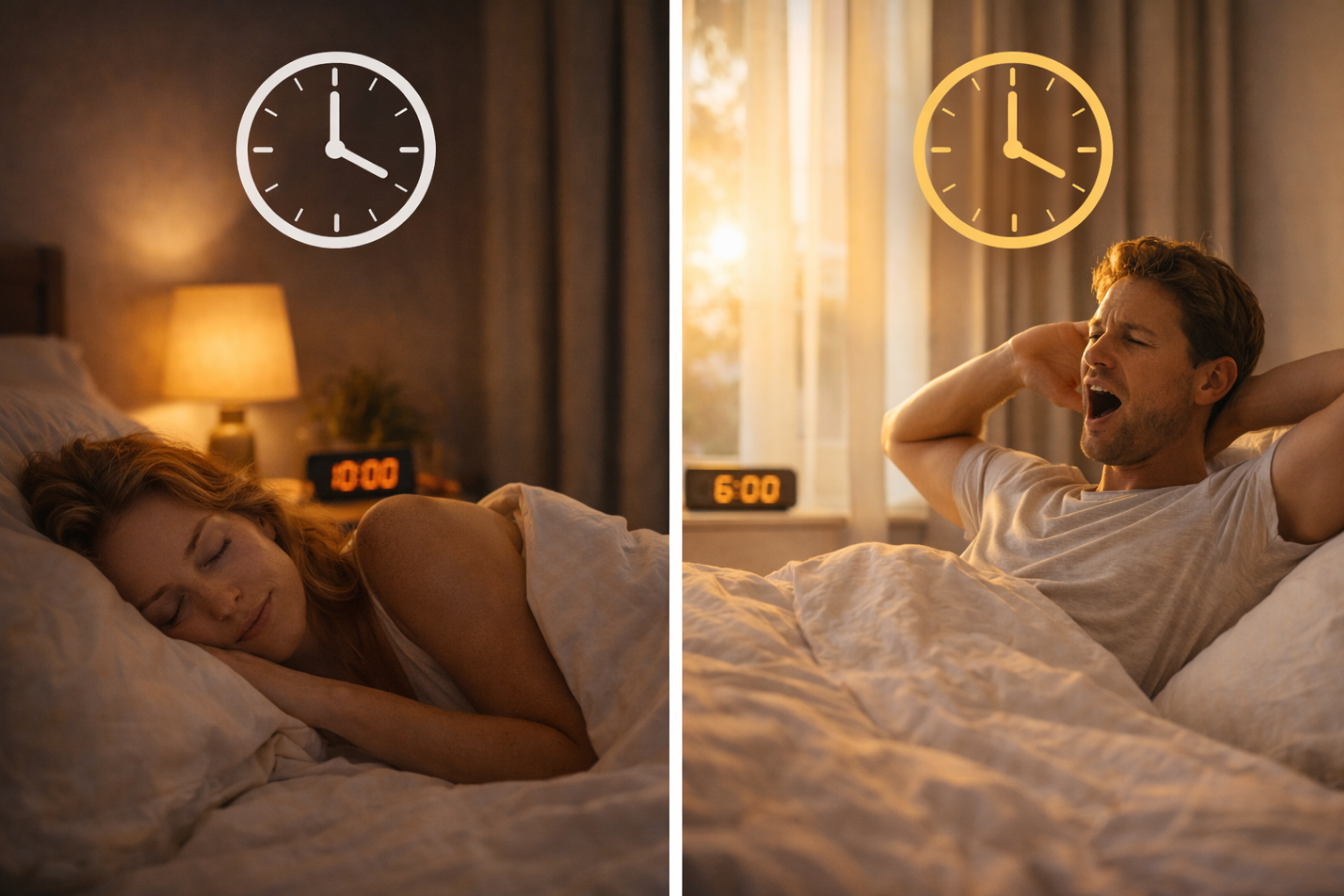
For example, a 6:45 am wake time pairs with a 10:30 pm to 6:45 am window. You may not sleep every minute. You are giving your system a stable container.
If your current bedtime drifts past midnight, shift gradually. Move bedtime earlier by 15 to 30 minutes every few nights while holding wake time steady. Avoid long late naps. Sleep pressure needs room to build.
This process feels slow. Biology adapts at its own pace.
The habits that make the scientifically best time to sleep and wake up stick
Habits, not willpower or data, determine sleep quality.
Morning behaviors matter more than elaborate night routines.
- Get early light exposure.
- Move your body in the first two hours, even briefly.
- Set a caffeine cutoff about eight hours before bed as a starting point. Caffeine taken even six hours before bed can reduce sleep time and depth Drake et al., 2013.
Evening habits should lower cognitive and light stimulation without becoming rigid rituals.
- Dim overhead lights in the last hour.
- Write the top three tasks for tomorrow, then close the laptop.
- Keep bedtime from becoming your only personal time.
Small environmental cues, repeated daily, shape circadian stability more reliably than bursts of motivation.
Wearables can guide you, but they cannot fix you
Devices such as Oura, WHOOP, Apple Watch, and Fitbit estimate sleep using motion and heart related signals. They are reasonably accurate for sleep versus wake. Precision for sleep stages is lower compared with laboratory polysomnography de Zambotti et al., 2019.
Wearables are not diagnostic tools. They cannot diagnose insomnia or sleep apnea.
Use them for patterns:
- Is your wake time consistent within 30 to 60 minutes?
- Do late meals or alcohol raise overnight resting heart rate?
- Do you feel better when weekend timing matches weekdays?
This is the loop that works. Metric to pattern to one behavior change to re check.
Tracking alone does not drive results. Behavior change does.
If you want deeper guidance on interpreting trends, our sleep coaching library walks through practical examples.
The uncomfortable habit most people avoid
Protect your weekend wake time.
A two or three hour sleep in feels restorative. Biologically, it can act like crossing time zones. Sunday night becomes harder. Monday feels heavy. Caffeine creeps later.
Keeping wake time within 60 minutes, even on weekends, is often the highest leverage move for stabilizing the scientifically best time to sleep and wake up.
If extra sleep is needed, shift bedtime earlier or take a short nap before 3 pm.
What not to do if you want better timing
Do not pick a bedtime out of fear. Anxiety increases arousal.
Do not use alcohol as a sleep aid. Alcohol can shorten sleep onset but fragments sleep later in the night Ebrahim et al., 2013.
Avoid solving fatigue with progressively later caffeine.
Resist the urge to chase perfect deep sleep scores. Stage data are estimates, not grades.
A simple seven day reset
Tonight:
- Choose your wake time and set one alarm.
- Plan morning light exposure.
- Dim lights in the last hour.
- If awake in bed for about 20 minutes, get up briefly in low light until sleepy. This principle comes from cognitive behavioral therapy for insomnia and reduces conditioned arousal.
For the next seven days:
- Hold wake time within 30 to 60 minutes daily.
- Keep naps short and earlier in the day.
- Notice patterns in wearable trends without overreacting to single nights.
The scientifically best time to sleep and wake up is the schedule your nervous system can trust. Perfection is not required. Stability is.
When rhythm stabilizes, many downstream problems soften. Mood steadies. Focus sharpens. Training improves. Relationships feel less strained.
If you want a personalized plan, a board certified sleep professional at Clementine can help you design a schedule around your life.
Progress over perfection. That is how sustainable sleep is built.
The scientifically best time to sleep and wake up is the schedule you can keep consistent most days while getting at least seven hours of sleep on average. Regularity supports circadian alignment, which makes sleep onset and morning wakefulness more predictable.
In most cases, yes. A consistent wake time anchors your circadian clock through light exposure and daily routines. Bedtime often shifts naturally earlier once wake time stabilizes.
Try to keep weekend wake time within 60 minutes of your weekday schedule. Larger swings increase social jetlag and often make Sunday and Monday nights more difficult.
GET IN TOUCH
Say goodnight to bad sleep
References
- American Academy of Sleep Medicine & Sleep Research Society. (2015). Recommended amount of sleep for a healthy adult. Sleep, 38(6), 843–844.
- Borbély, A. A. (1982). A two process model of sleep regulation. Human Neurobiology, 1(3), 195–204.
- de Zambotti, M., et al. (2019). Wearable sleep technology in clinical and research settings. Medicine & Science in Sports & Exercise, 51(7), 1538–1557.
- Drake, C., et al. (2013). Caffeine effects on sleep taken 0, 3, or 6 hours before bedtime. Journal of Clinical Sleep Medicine, 9(11), 1195–1200.
- Ebrahim, I. O., et al. (2013). Alcohol and sleep I: Effects on normal sleep. Alcoholism: Clinical and Experimental Research, 37(4), 539–549.
- Huang, T., et al. (2020). Sleep irregularity and risk of cardiovascular events. Journal of the American College of Cardiology, 75(9), 991–999.
- Khalsa, S. B. S., et al. (2003). A phase response curve to single bright light pulses in humans. The Journal of Physiology, 549(3), 945–952.
- National Institute of General Medical Sciences. (2023). Circadian rhythms.
- Wittmann, M., et al. (2006). Social jetlag: Misalignment of biological and social time. Chronobiology International, 23(1–2), 497–509.