
Sleep better, naturally. Starting tonight.
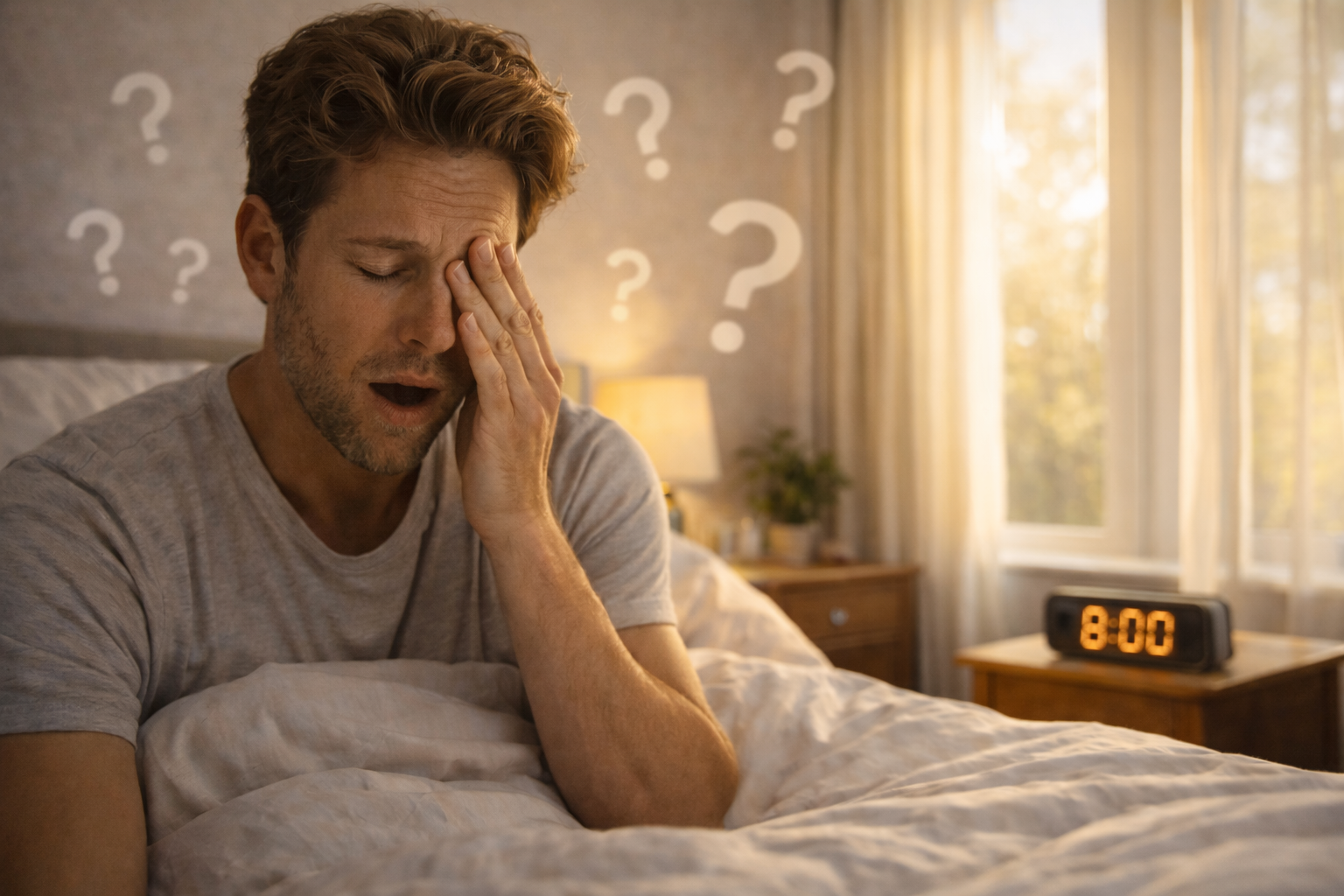
If you are asking why am I tired after 8 hours of sleep, this article is for you. You will learn what may be disrupting your deep sleep and REM, and which simple habit shifts can help you wake up restored.
Key takeaways
- Eight hours in bed does not guarantee restorative deep sleep and REM.
- Sleep continuity, not just duration, drives next-day energy and mood.
- Habits, not tracking alone, are what rebuild sleep architecture.
You can do everything “right” and still wake up exhausted
You get in bed on time. You log eight hours. Your Oura or WHOOP shows a full night. At 7:15am, you feel like your body never recovered.
This is the hidden frustration behind the search why am I tired after 8 hours of sleep. It is not laziness. It is not a character flaw. For many high-functioning adults, it is not even a diagnosable disorder.
In many cases, the issue is a mismatch between sleep duration and sleep restoration. Deep sleep and REM can be reduced or fragmented even when total sleep time looks normal. When that happens, you can accumulate eight hours and still wake up under-restored.
The encouraging part is this. Sleep architecture often improves when upstream habits improve. Not through willpower. Not through obsessing over data. Through small, consistent shifts that help your nervous system downshift and stay down.
Why am I tired after 8 hours of sleep? The quick explanation
If you are asking why am I tired after 8 hours of sleep, the most common non-medical reasons include:
- You spent eight hours in bed, but less time actually asleep.
- Your sleep was fragmented, reducing consolidated deep sleep and REM.
- Your circadian rhythm is slightly misaligned with your schedule.
- Alcohol, stress, late meals, caffeine, or light increased nighttime arousal.
- You woke during a deeper stage and felt strong sleep inertia.
If fatigue is new, worsening, or severe, medical causes are worth ruling out. Conditions like sleep apnea, thyroid disorders, anemia, and depression can all affect energy. This article focuses on non-clinical drivers, but it does not replace medical care.
You can “sleep enough” and still miss what restores you
Sleep is not one uniform state. It cycles through stages across the night.
Two stages matter most for how you feel the next day.
- Deep sleep, also called slow-wave sleep, supports physical restoration, immune function, and metabolic regulation. It is more concentrated in the first half of the night.
- REM sleep supports emotional processing, learning, and cognitive flexibility. It is more concentrated in the second half of the night.
That is the basic physiology. The nuance is where most people get stuck.
You can achieve a normal total sleep time while still losing deep sleep and REM to fragmentation. Fragmentation refers to brief awakenings or micro-arousals that you may not remember. Even subtle arousal can shift you into lighter sleep and reduce consolidated slow-wave and REM sleep.
Population-level research shows that sleep continuity is closely tied to next-day alertness and performance, not just total hours (Stepanski, 2002; Medic et al., 2017). The American Academy of Sleep Medicine also emphasizes that sleep quality matters alongside duration (AASM, 2015).
Sleep science is still evolving. We cannot perfectly map a single night of “low REM” to how you will feel the next morning. Individual variation is real. Still, consistent fragmentation tends to predict worse recovery.
The myth that keeps people stuck
The popular belief is simple. If I got eight hours, I should feel fine.
Hours are necessary. They are not sufficient.
Your brain protects wakefulness when it senses stress, stimulation, or novelty. Emotional pressure, late caffeine, bright light, and heavy meals can all increase arousal. You may fall asleep, yet your nervous system never fully disengages.
Lab studies show that increased nighttime arousal is associated with lighter sleep and more awakenings (Riemann et al., 2010). The result is subtle but meaningful. Less consolidated deep sleep. Less stable REM. More next-day fatigue.
Sleep is the foundation of mood, metabolism, cognition, fitness, relationships, and long-term brain health. When restoration is shallow, every domain feels harder.
9 reasons you feel tired after 8 hours of sleep
1) You are counting time in bed, not time asleep.
Sleep efficiency matters. Eight hours in bed with 60 minutes awake equals a smaller sleep dose. Wearables estimate this, but quiet wake is often misclassified as light sleep.
2) Stress physiology is fragmenting your night.
Cortisol should rise in the morning, not at midnight. Chronic stress can create hyperarousal that persists into sleep (Riemann et al., 2010). You do not need clinical insomnia to experience this pattern.
If your mind feels active at night, this guide on racing thoughts that stop you from sleeping may help you shift state gently.
3) Evening light is delaying your circadian rhythm.
Bright light at night suppresses melatonin and delays sleep timing (Chang et al., 2015). Overhead LEDs and close screen use both matter. The mechanism is biological, not moral.
4) Alcohol is reducing REM and fragmenting the second half.
Alcohol may shorten sleep latency. Later in the night, it often increases awakenings and alters REM distribution (Ebrahim et al., 2013). The pattern feels like eight hours of sleep with poor recovery.
5) Late meals are increasing arousal.
Heavy food close to bedtime raises core temperature and activates digestion. For some, reflux-like symptoms cause micro-awakenings. A two-week experiment of earlier dinners can be revealing.
6) You are waking during deeper sleep.
Sleep inertia is stronger when waking from slow-wave sleep. You cannot perfectly time 90-minute cycles, but a consistent wake time improves alignment.
7) Your bedroom environment is subtly disruptive.
Temperature, light leakage, and intermittent noise all fragment sleep. Small environmental changes often produce outsized results. This overview on how to make your bedroom good for sleep covers practical adjustments.
8) Caffeine is masking sleep pressure.
Caffeine blocks adenosine, the chemical signal of sleep drive. You may fall asleep, yet your sleep can become lighter. Sensitivity increases with age and stress load.
9) Your wearable says “sleep,” but your body experienced wake.
Devices like Oura, WHOOP, Apple Watch, and Fitbit are helpful for trends. They are not diagnostic tools. Stage classification accuracy varies and does not equal laboratory polysomnography (de Zambotti et al., 2019).
Use wearable data to test habits. Avoid treating a score as a verdict on how you should feel.
The habit shifts that restore sleep architecture first
If you want leverage, aim at continuity. Habits shape physiology. Data alone does not.
Set a consistent wake time.
A stable wake time anchors circadian rhythm. Let bedtime follow sleepiness. This approach comes from behavioral sleep medicine and often improves efficiency.
Create a 30-minute low-stimulation buffer.
Lower light. Lower cognitive load. Gentle, repeatable cues work best. These calming activities before bed are practical and sustainable.
Protect the second half of the night.
REM is denser later. Cutting sleep short often trims REM disproportionately.
Use morning light as a reset.
Outdoor light within an hour of waking stabilizes circadian timing (Khalsa et al., 2003). Even five to ten minutes helps.
Change one variable at a time.
Track morning energy and afternoon crash for two weeks. Let your wearable provide context, not pressure.
The uncomfortable habit most people avoid
Stop going to bed early when you are not sleepy.
It feels responsible. For many people, it backfires. Extra time in bed often increases wakefulness and weakens the bed-sleep association.
The alternative is simple, not easy. Keep your wake time steady. Allow bedtime to drift later until sleep onset becomes smoother. As efficiency improves, bedtime often shifts earlier naturally.
What not to do when you are tired after 8 hours
- Do not chase deep sleep scores nightly.
- Do not add new supplements every week.
- Do not extend weekend sleep if it shifts your body clock.
- Do not work in bed.
- Do not rely on tracking without changing behavior.
Tracking alone does not drive results. Consistent habits do.
A simple 7-day reset
For one week:
- Wake within the same 30-minute window daily.
- Get morning light within 60 minutes.
- Stop caffeine at least eight hours before bed.
- Finish dinner two to three hours before sleep.
- Keep the last 30 minutes low light and low stimulation.
- If awake for more than 20 to 30 minutes overnight, get up briefly in dim light until sleepy.
Rate morning energy and afternoon crash from one to ten. Look for trends, not perfection.
Progress is the goal. Small shifts in continuity compound into better mood, sharper thinking, steadier metabolism, and more resilient energy.
If you want personalized guidance, you can request a complimentary consult with a board-certified sleep professional at Clementine.
Wearables estimate sleep based on movement and heart rate. They can miss quiet wake and micro-arousals. A “good” score does not guarantee consolidated deep sleep and REM. Use trends to guide habit changes, not to judge how you should feel.
Midlife often brings lighter, more fragmented sleep due to stress load, circadian shifts, and gradual reductions in slow-wave sleep. Improving sleep continuity and protecting the second half of the night can still meaningfully improve restoration.
Seek medical care if you have loud snoring, gasping, breathing pauses, severe daytime sleepiness, morning headaches, high blood pressure, or unexplained fatigue. Behavioral factors are common, but medical causes should be ruled out when symptoms are significant.
GET IN TOUCH
Say goodnight to bad sleep
References
- American Academy of Sleep Medicine & Sleep Research Society. (2015). Recommended amount of sleep for a healthy adult: A joint consensus statement. Sleep, 38(6), 843–844.
- Chang, A. M., Aeschbach, D., Duffy, J. F., & Czeisler, C. A. (2015). Evening use of light-emitting eReaders negatively affects sleep, circadian timing, and next-morning alertness. Proceedings of the National Academy of Sciences, 112(4), 1232–1237.
- de Zambotti, M., Cellini, N., Goldstone, A., Colrain, I. M., & Baker, F. C. (2019). Wearable sleep technology in clinical and research settings. Medicine & Science in Sports & Exercise, 51(7), 1538–1557.
- Ebrahim, I. O., Shapiro, C. M., Williams, A. J., & Fenwick, P. B. (2013). Alcohol and sleep I: Effects on normal sleep. Alcoholism: Clinical and Experimental Research, 37(4), 539–549.
- Khalsa, S. B., Jewett, M. E., Cajochen, C., & Czeisler, C. A. (2003). A phase response curve to single bright light pulses in humans. Journal of Clinical Investigation, 111(4), 523–531.
- Medic, G., Wille, M., & Hemels, M. E. (2017). Short- and long-term health consequences of sleep disruption. Sleep Medicine Reviews, 32, 91–105.
- Riemann, D., Spiegelhalder, K., Feige, B., et al. (2010). The hyperarousal model of insomnia. Nature Reviews Neuroscience, 11(9), 589–599.
- Stepanski, E. J. (2002). The effect of sleep fragmentation on daytime function. Sleep, 25(1), 41–48.