
Sleep better, naturally. Starting tonight.
This article is for adults who hit the recommended hours of sleep by age but still wake up tired. You will learn what the numbers miss and how to improve real, restorative sleep starting tonight.
Key takeaways
- The recommended hours of sleep by age are a starting range, not a personalized prescription.
- Sleep quality depends on continuity, timing, and sleep architecture, not just total hours.
- Habits, not willpower or data, determine sleep quality and long-term health.
When 7 to 9 hours still feels like not enough
Monday morning can feel unfair.
You did the right thing. You got 7.5 hours. Your Oura or WHOOP still calls it mediocre. You are not sick. You are not hungover. Yet you feel flat and foggy before the week even starts.
This is why the question of recommended hours of sleep by age can feel deceptively simple. The chart answer is easy. The useful answer is harder. After 40, the issue is often not that you suddenly need far more hours. The same number of hours can contain less biological recovery.
Sleep is the foundation of cognition, mood, metabolism, fitness, relationships, creativity, productivity, and long-term brain health. When it erodes, everything feels heavier. So yes, we will cover the recommended hours of sleep by age. We will also look at what the number cannot tell you and how to rebuild restorative sleep without chasing pills or perfect scores.
The recommended hours of sleep by age are a baseline, not a plan
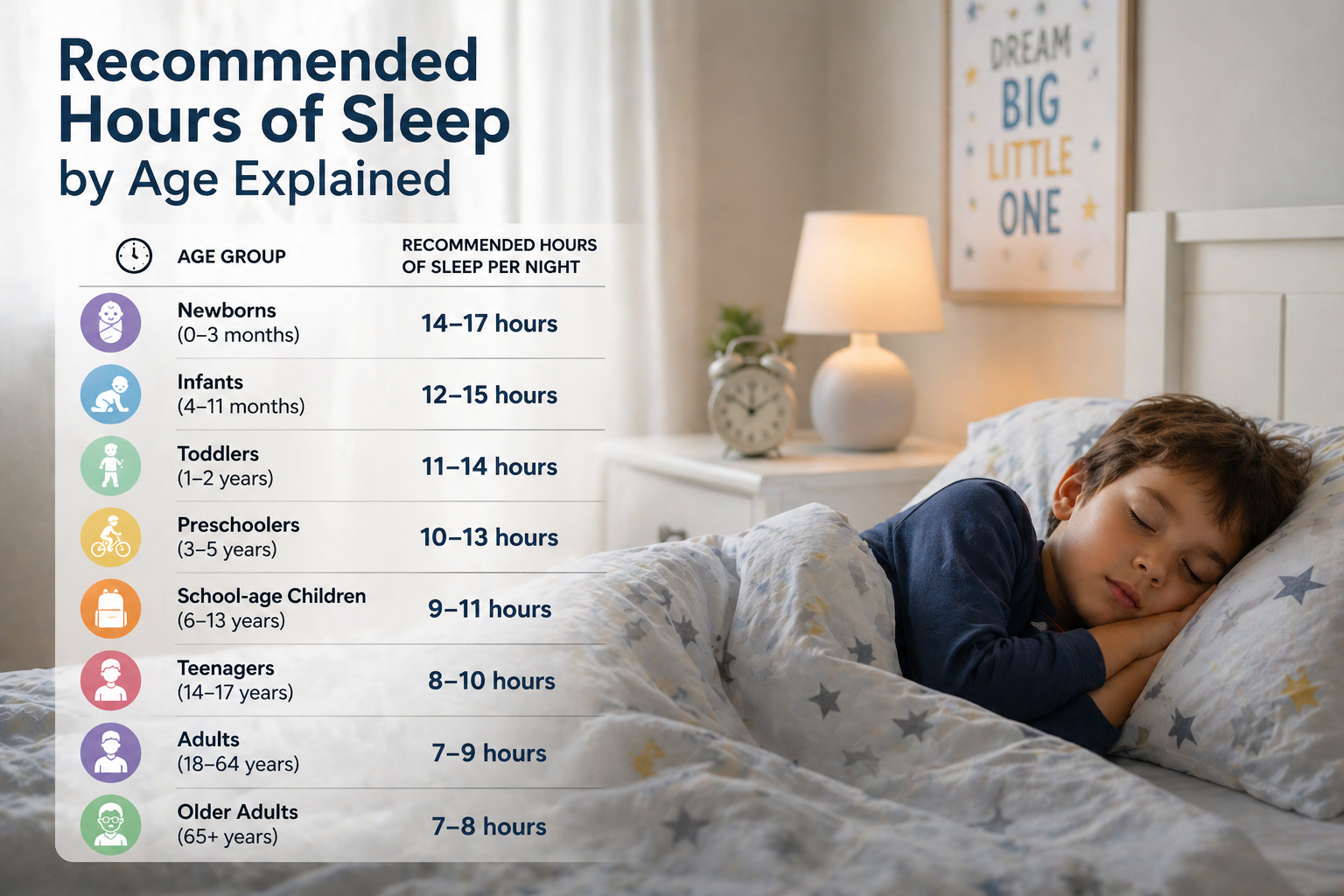
Most major sleep organizations provide similar ranges:
- Teens 14 to 17 years: 8 to 10 hours
- Young adults 18 to 25 years: 7 to 9 hours
- Adults 26 to 64 years: 7 to 9 hours
- Older adults 65 and older: 7 to 8 hours
These ranges align with the National Sleep Foundation and the joint consensus statement from the American Academy of Sleep Medicine and Sleep Research Society Watson et al., 2015. They are built from population data and expert review. They cover most people, most of the time.
However, population guidance cannot account for your stress load, travel, alcohol intake, menopause transition, chronic pain, or sleep fragmentation. The recommended hours of sleep by age are guardrails. They are not a precision tool that tells you that you personally need 7 hours and 42 minutes.
If you want to think about timing alongside duration, this guide on the scientifically best time to sleep and wake up explains how consistent wake times shape recovery.
The myth: “If I hit 8 hours, I should feel great”
This belief is common. It is also incomplete.
Sleep is not one uniform state. It cycles through stages, including deeper non REM sleep and REM sleep. The structure and sequence of these stages is called sleep architecture. You can be in bed for 8 hours and still miss meaningful restoration if your sleep is fragmented or mistimed.
Research shows that slow wave sleep, often called deep sleep, tends to decline across adulthood, with wide individual variation Ohayon et al., 2004. Many adults also experience more brief awakenings. Both changes can blunt the feeling of recovery even when total sleep time sits inside the recommended hours of sleep by age.
Biology does not work like a bank account. You cannot deposit hours and expect a fixed energy return. Mechanism matters more than the number.
What the number cannot tell you
A simple framework helps:
- Sleep quantity: How long did I sleep?
- Sleep continuity: How broken up was it?
- Sleep timing: When did I sleep relative to my body clock?
- Sleep architecture: Did I cycle through deep and REM sleep in a healthy pattern?
Guidelines focus mostly on quantity. Your experience is usually driven by the other three.
For example, if sleep latency is short but you wake at 3 a.m. and lie awake for 45 minutes, your total may still land in the recommended hours of sleep by age. Your brain may still feel under-recovered. If early awakenings are common for you, this article on why you keep waking up at 2am outlines common drivers.
Where sleep science is nuanced
It is important to separate strong evidence from confident marketing.
Wearables estimate sleep stages using movement and heart rate patterns. They do not measure brain waves like an overnight sleep study. Stage data can be directionally useful. It is not a diagnosis.
Magnesium may help people with deficiency or muscle tension. Melatonin can shift circadian timing when used correctly. Neither is a universal deep sleep switch. Evidence is mixed and timing matters.
Aging does not automatically mean you need less sleep. Older adults often sleep less, but this can reflect health conditions, medications, pain, or circadian shifts rather than a reduced biological requirement.
An honest approach respects the recommended hours of sleep by age while admitting uncertainty. Use the range as a starting point. Then test behaviors that influence continuity, timing, and architecture.
Habits that improve sleep quality after 40
At Clementine, we repeat this often: habits, not willpower or data, determine sleep quality. Tracking can reveal patterns. Tracking alone does not drive results. Behavior change does.
Anchor your wake time.
A consistent wake time strengthens your circadian rhythm and helps sleep pressure build across the day. Keep it within about 30 to 60 minutes, even on weekends. This single habit often stabilizes nights more than extending time in bed.
Use light strategically.
Get outdoor light within an hour of waking. Five to ten minutes on a bright day is enough. Extend to 15 to 20 minutes if it is cloudy. In the evening, dim overhead lights when possible. Light is a primary signal to your brain’s clock.
Protect the last hour.
High performers often struggle with transition, not discipline. Choose two calming, repeatable activities. Keep them low friction and low light. If you need ideas, this list of calming activities before bed for adults offers simple options.
Shape the environment.
A cool, dark, quiet room supports deeper sleep. Boring works. This guide on how to make your bedroom good for sleep walks through practical adjustments.
The uncomfortable habit that works
Get out of bed if you are awake and alert.
Most people stay in bed and try harder. They scroll. They negotiate with the clock. Over time, the bed becomes linked with frustration. Cognitive behavioral therapy for insomnia uses stimulus control to rebuild the bed sleep connection. This approach has strong support in clinical guidelines from the American Academy of Sleep Medicine AASM, 2021.
If you are awake long enough to feel wired, get up in low light. Do something quiet for 10 to 20 minutes. Return when sleepy. It feels counterintuitive. It is high leverage.
Using wearables without letting them run your life
Oura, WHOOP, Apple Watch, and Fitbit can detect trends in duration and timing. They can flag restless nights. They can estimate recovery using heart rate and heart rate variability.
They cannot diagnose sleep disorders or precisely measure deep versus REM sleep. Treat stage data as a pattern signal.
A simple behavior loop looks like this:
- Pick one metric for two weeks.
- Pair it with one realistic habit.
- Keep other variables stable.
- Review trends, not single nights.
For deeper recovery, this guide on how to increase deep sleep naturally focuses on levers that influence physiology, not gimmicks.
What not to do when chasing the recommended hours of sleep by age
- Do not add extra time in bed just in case. More time awake in bed reduces sleep efficiency.
- Do not panic after one poor night. Variability is normal.
- Do not use alcohol as a sleep tool. It can shorten sleep latency but fragment the second half of the night and suppress REM sleep National Institute on Alcohol Abuse and Alcoholism.
- Do not escalate caffeine to compensate. It can delay sleep and reinforce the cycle.
- Do not rotate supplements weekly. You will not know what is helping.
A two week reset for adults over 40
Use the recommended hours of sleep by age as your range. Then tighten the basics for two weeks.
- Keep wake time within 60 minutes daily.
- Get morning outdoor light.
- Stop caffeine about 8 hours before bed, adjusted for sensitivity.
- Finish alcohol and heavy meals at least 3 hours before bed.
- Dim lights during the last hour.
- Keep the room cool, dark, and quiet.
- If awake and alert, get out of bed briefly.
Judge progress by morning energy and mood first. Use wearable scores as supporting evidence. One week is noise. Two to four weeks is signal.
You are not failing the sleep chart
The recommended hours of sleep by age are useful. They are not the full story. For many adults over 40, the win is better architecture and fewer disruptions, not obsessing over a perfect number.
Progress looks like fewer rough Mondays and steadier focus. It shows up as emotional resilience and more consistent training. Restorative sleep supports every other health domain. When sleep improves, everything else becomes easier to change.
If you want a personalized starting point, a complimentary assessment with a board certified sleep professional at Clementine can help you build a protocol around your schedule and patterns.
You are not broken. You are upgrading the system.
For most adults ages 26 to 64, the recommended hours of sleep by age are 7 to 9 hours per night. If you are over 40 and still tired within that range, sleep fragmentation, timing, or reduced deep sleep may be the issue rather than total hours.
Eight hours in bed does not guarantee restorative sleep. Frequent awakenings, late light exposure, alcohol, stress, or misaligned circadian timing can reduce deep and REM sleep even when total duration matches the recommended hours of sleep by age.
Not necessarily. Older adults often sleep less, but this may reflect health conditions, medications, or circadian shifts rather than a lower biological need. The typical recommendation for adults over 65 is 7 to 8 hours, though individual needs vary.
Wearables estimate sleep stages using movement and heart rate patterns. They can show trends, but they cannot measure brain waves like a sleep study. Use deep sleep data as a pattern signal, not a diagnosis.
GET IN TOUCH
Say goodnight to bad sleep
References
- Watson, N. F., et al. (2015). Recommended amount of sleep for a healthy adult: A joint consensus statement. Sleep, 38(6), 843–844.
- Ohayon, M. M., Carskadon, M. A., Guilleminault, C., & Vitiello, M. V. (2004). Meta-analysis of quantitative sleep parameters from childhood to old age in healthy individuals. Sleep, 27(7), 1255–1273.
- American Academy of Sleep Medicine. (2021). Behavioral and psychological treatments for chronic insomnia disorder in adults: Clinical practice guideline. Journal of Clinical Sleep Medicine, 17(2), 255–262.
- National Institute on Alcohol Abuse and Alcoholism. (n.d.). Alcohol and sleep.